Pesticide-freeDry capture surface
Bio-inspired home protection
Nature's trap.
Re-engineered
for your home.
Bio-inspired capture strips designed to stop crawling and flying insects—without pesticides, fumes, or messy exposed glue.
Concept product · Prototype validation required
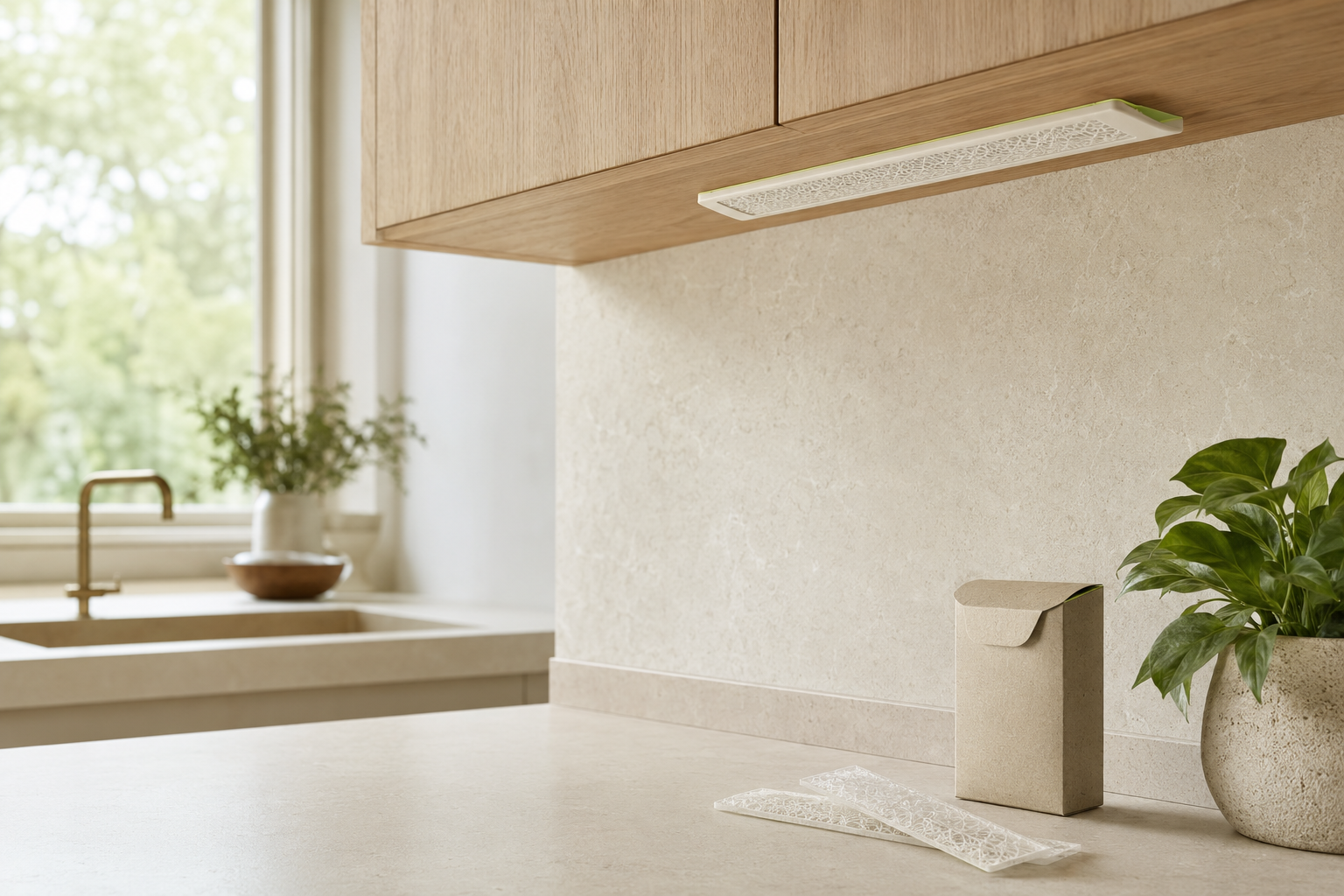
01 / Starter systemSilkLock™ Matrix
Dry cellulose microfibers in a guarded, low-profile strip.
Discreet under-cabinet placement
How it works
A cleaner way to catch what wanders in.
Spider Web Strips borrow the geometry of a web—not its stickiness. The dry, high-surface-area lattice is designed to interrupt an insect's footing and hold wings and legs inside a protected channel.
Guide
A tapered entry lip channels insects toward the capture zone along common travel edges.
Entangle
Electrospun cellulose microfibers create thousands of dry contact points for legs and wings.
Replace
A color-change edge is designed to signal a 30-day service interval or a filled strip.
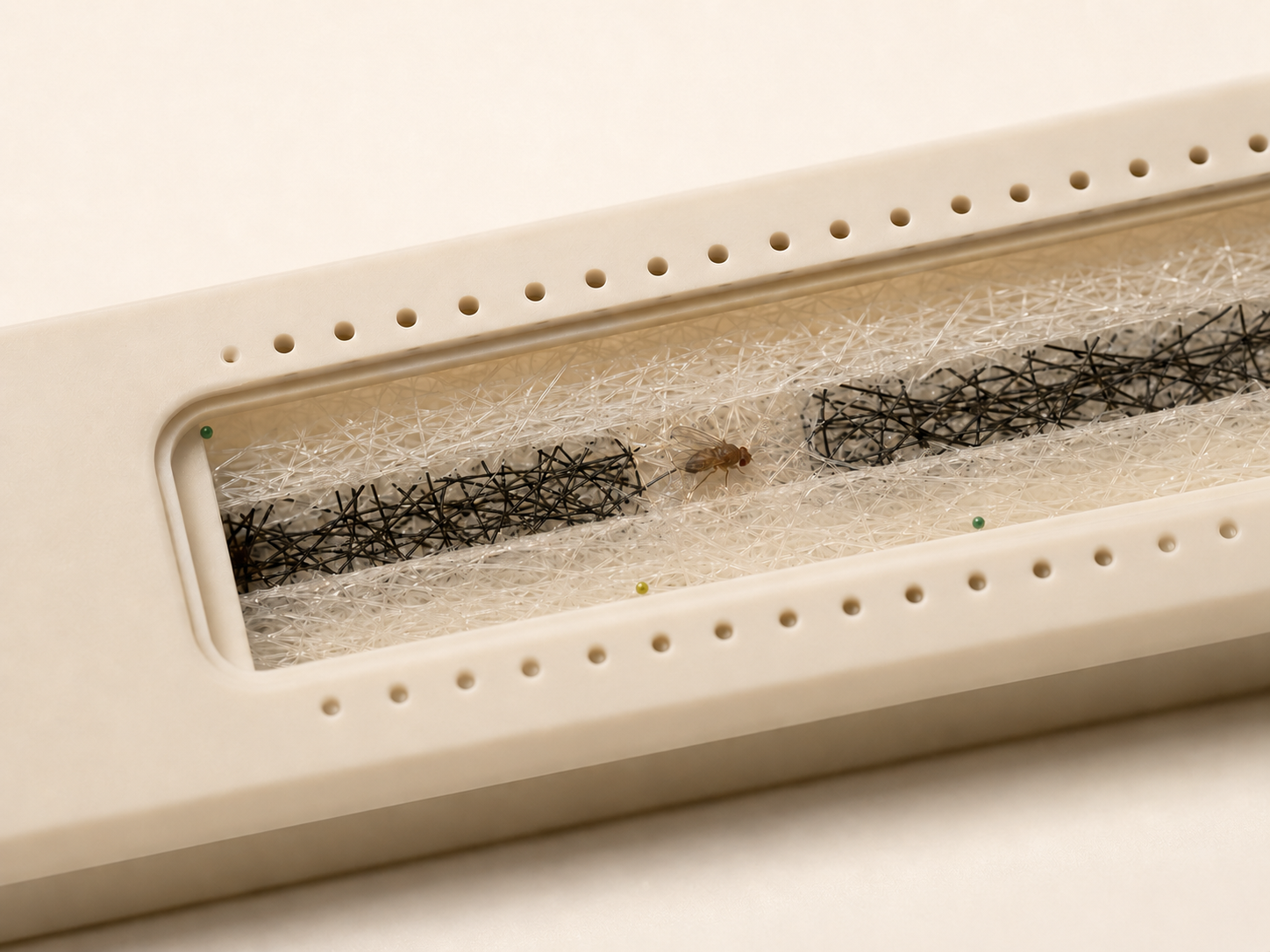 Material study / 01
The material
Introducing the SilkLock™ Matrix.
An invented dry-capture composite that pairs a plant-derived microfiber lattice with a recyclable protective housing.
Cellulose nanofiber web
Electrospun fibers create a random, spider-silk-like lattice with no wet adhesive.
Triboelectric boost
A mineral-polymer blend is designed to retain a mild passive static charge from ambient movement.
Guarded bio-frame
A molded cellulose shell recesses the capture surface away from casual touch.
Prototype specificationTarget profile: 310 × 34 × 7 mmValidation: efficacy, toxicology, durability
Place with purpose
Hidden from sight. Right in their path.
Install along insect travel edges—not in the middle of a room. Keep every strip dry and out of reach of children and animals.
Under cabinets
Near sinks, produce bowls, and counter edges where fruit flies and crawling insects travel.
Along frames
On upper or side frames near plants and light, away from curtains and open airflow.
Behind shelves
Close to wall edges and dry-food storage, without touching food or food-contact surfaces.
The system
Start small.
Cover the right spaces.
Concept pricing shown for market testing. No payment is collected.
Home starter kit
4 strips + placement guide
Kitchen, window, pantry, and utility-room coverage.
$24
Refill pack
8 SilkLock™ inserts
Keep the housings. Replace only the capture matrix.
$18
IP & secure validation
Build the moat before revealing the formula.
Protect Spider Web Strips as a coordinated portfolio: inventions, brands, confidential know-how, creative assets, test data, and clean ownership contracts. Public materials explain the benefit; restricted records preserve the recipe and proof.
Safe to showPurpose, placement, user benefits, and carefully qualified concept claims.
Keep restrictedFormulas, tolerances, machine settings, source CAD, raw datasets, models, and failure limits.
Patent architecture
Protect the system, not just one strip.
Evaluate utility claims around the dry-capture matrix, fiber geometry, passive charge behavior, guarded cartridge, change indicator, manufacturing method, and use. Consider design protection for the visible housing and refill interface.
File before the next detailed demo, supplier package, or publication.Brand & expression
Clear SilkLock™ before filing.
Run a comprehensive trademark clearance for SilkLock and Spider Web Strips, then protect the chosen word marks and logos. Register eligible code, technical drawings, manuals, packaging, photography, and website content separately from the invention.
Trade-secret core
Keep the reproducible recipe secret.
Restrict fiber diameters and distributions, material ratios, electrospinning settings, surface treatments, QA thresholds, simulation parameters, training data, negative results, and supplier specifications on a need-to-know basis.
Chain of title
Make ownership unambiguous.
Use signed invention assignments and confidentiality terms with founders, employees, contractors, laboratories, manufacturers, and simulation partners. Contracts should define background IP, new IP, data ownership, permitted use, retention, return, and deletion.
Public-disclosure checkpoint
Preserve dated copies of everything already shown, tell patent counsel exactly what was disclosed and when, and do not assume a U.S. grace period protects foreign rights. A provisional filing is a priority-date tool—not an issued patent—and must be followed on schedule.
SilkLock secure evidence pipeline
Simulate privately. Validate physically. Release selectively.
NVIDIA Omniverse and PhysicsNeMo can support a private digital twin, physics-informed models, visualization, and design-space studies. They do not replace controlled laboratory trials, regulatory review, or independent verification—and their use does not imply NVIDIA endorsement or certification.
Versioned requirements, threat model, claims, and test protocol.
OpenUSD geometry, airflow, deformation, humidity, dust, charge decay, and insect-path scenarios.
Coded specimen lots with controlled materials, settings, and operator records.
Randomized controls, species-specific efficacy, safety, shedding, aging, and disposal tests.
Signed results, hashes, approvals, retained samples, and a claim-to-evidence release record.
Secure the underlying work
SilkLock R&D Vault
- Identity Named accounts, MFA, least privilege, quarterly access review.
- Data Encryption in transit and at rest; separate public, partner, and restricted zones.
- Evidence Immutable run IDs, timestamps, hashes, approvals, and append-only audit logs.
- Partners NDA plus no secondary use, no model training, retention limits, and verified deletion.
- Recovery Offline backup, incident plan, vendor exit package, and tested restoration.
Claim-to-evidence gate
No claim ships without a record.
Dry captureHigh-speed video + matched controls
30-day cycleHumidity, dust, accelerated aging + field data
Low sheddingParticle count + handling and vibration test
Species efficacyBlinded, replicated, species-specific protocol
Household useToxicology, exposure, placement + labeling review
Official starting pointsUSPTO IP toolkits ↗Provisional applications ↗Trademark clearance ↗NIST CSF 2.0 ↗NVIDIA Omniverse ↗NVIDIA PhysicsNeMo ↗
Program blueprint for planning purposes, not legal, regulatory, or safety advice. Engage qualified patent, trademark, product-safety, and regulatory counsel before filing, testing, or making commercial claims.
Questions, answered
The small print
about a small strip.
Is it sticky?
The concept uses a dry microfiber lattice rather than an exposed pressure-sensitive glue. The backing adhesive only mounts the guarded housing to a surface.
Which insects is it designed for?
The first prototype would target fruit flies, gnats, pantry moths, ants, and other small household insects. Species-by-species testing would be required.
Is it safe around pets and children?
The recessed housing reduces casual contact, but the concept still requires placement out of reach and formal safety validation before any safety claim can be made.
Why change it every 30 days?
Thirty days is the proposed service interval for the concept. Actual replacement timing would depend on loading, dust, humidity, and results from durability testing.
Is SilkLock™ already patented or registered?
No protection is claimed by this concept site. SilkLock™ is a proposed brand name that requires clearance, and any patent protection would require properly prepared filings and examination. Detailed formulations and test assets should remain restricted until counsel sets the filing and trade-secret strategy.
Can simulation prove the product works?
No. NVIDIA-based simulation can narrow the design space and create traceable hypotheses, but product claims must be supported by controlled physical testing, appropriate safety work, and any required regulatory review.
Early access
Help bring the web indoors.
Join the concept list for prototype updates, field-test opportunities, and launch news.